For the better part of the industrial age, organizations have operated with a distinct and intentional divide. On one side, there was Information Technology (IT)—the corporate realm of data centers and supply chain management. On the other stood Operational Technology (OT)—the shop floor domain of physical machinery and industrial control systems.
Today, this “air gap” has transformed from a safety feature into a strategic liability. At STL Digital, we are seeing the acceleration of Digital Transformation in Business systematically dismantle these walls. By merging the carpeted office with the concrete factory floor, enterprises can finally unlock the resilience and innovation required for the next industrial era.
The Convergence Driver: Why Integration is Non-Negotiable
The historic reluctance to integrate these domains stemmed from valid concerns. OT systems were often legacy platforms, some running for decades without updates, built on proprietary protocols that did not speak the language of modern TCP/IP networks. Connecting them to the corporate network introduced cybersecurity risks that operations managers were notoriously unwilling to accept.
However, the business cost of isolation has become too high to ignore. In a siloed environment, operational data is often trapped in the machine that generated it. A production manager might review efficiency reports days or weeks after a run is completed, meaning defects or inefficiencies are identified only after the damage is done. This latency creates a “rearview mirror” approach to management, where decisions are made based on historical data rather than current reality.
Today, the proliferation of edge computing, low-latency 5G connectivity, and sophisticated industrial sensors has made real-time visibility possible. When operational data is liberated from the shop floor and fed into broader IT analytics platforms, it transforms from static records into dynamic, actionable intelligence. This shift is the engine behind true Digital Transformation in Business, allowing companies to pivot from reactive troubleshooting to predictive orchestration.
1. Unlocking Operational Efficiency and Output
The first and most obvious effect of silo busting is the increased efficiency of operations. Integration enables so-called Digital Twins — virtual copies of the physical assets— where engineers can test without interfering with production.
The scale of this transition is evident in global investment trends. According to the IDC FutureScape 2026 Predictions, the region’s IT spending is growing by 7% to reach $1.123 trillion in 2026, driven by the transition from experimentation to an era where technology acts with more autonomy. This massive capital allocation signals that businesses view connected operations not as experimental, but as essential infrastructure to drive economic value.
2. Data-Driven Decision Making at Scale
An organization that is siloed will always make decisions with disjointed perceptions of reality. The finance team perceives the world in terms of costs and revenue, the supply chain team in terms of inventory level and the operations team in terms of machine uptime and throughput. Integration of such perspectives is very rare in real-time and will create friction and sub-optimal forecasting.
IT-OT integration develops a single pane of glass where these two different data points meet. The manufacturers can synchronize their complete value chain by feeding the shop-floor data straight into the Enterprise Applications. As an example, when the pace of production on the factory floor slows down suddenly, an update made to the ERP system will automatically adjust the delivery schedule among the customers and will halt the order of raw materials to avoid bloat in inventory. Such a high degree of synchronization necessitates a shift in terms of legacy patchworks management to a single data structure.
This urgency of the transition is manifested in the strategic priorities of global leadership. The KPMG 2024 Industrial Manufacturing and Automotive CEO Outlook reveals that 53% of CEOs now identify the race to embed generative AI and advanced technologies into their operations as a top priority. This statistic indicates that leaders are no longer viewing data integration as an experimental side project but as the core battlefield for future competitiveness.
3. Empowering the Connected Workforce
Technology is eventually as good as the individuals who operate it. The empowerment of the frontline workforce is one of the benefits of IT-OT convergence that should not be disregarded. In a more traditional system, a technician who needed to fix a complex part of machinery would have to go off the floor and consult a hardcopy manual or log into a different terminal to look at the history of maintenance. Such a disconnection makes the process of repairing slow and predisposes it towards an error.
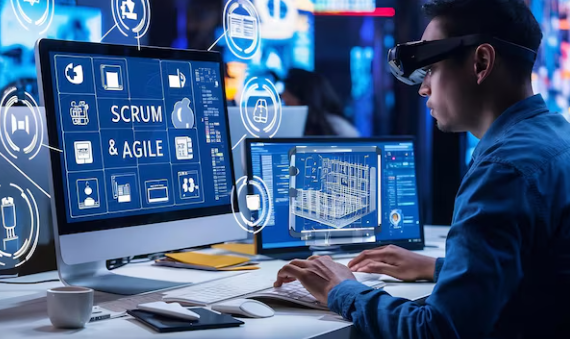
This information is taken directly where it is required through integration. Movable equipment technicians can superimpose computer-based schematics on the machine itself, using a mobile machine or an augmented reality (AR) wearable, retrieving IT-hosted manuals, repair videos, and inventory information in real-time. Such augmented capability is a significant narrowing of the skills gap that is a decisive issue in the manufacturing industry because older workers are retiring and a more digital generation replaces the older age bracket.
Research supports the growing reliance on these tools. Gartner predicts that by 2027, 25% of CIOs will utilize augmented-connected workforce initiatives to reduce the time to competency for key roles by 50%. By bridging the data gap, companies are not just upgrading their machines; they are upskilling their human capital to adapt to increasingly complex industrial environments.
Navigating the Security Challenge
Although the advantages of IT integration with OT are evident, the integration of information and operations technologies poses an important challenge: cybersecurity. The “air gap” was a formidable physical defense, and removing it exposes OT systems—many of which were never designed to be internet-facing—to the same threat landscape that plagues corporate IT networks. An attack of ransomware that previously could have only involved encrypting office files, now has the potential of shutting down a production line, or compromising safety systems, or even ruining perishable goods.
Security by design should hence be a priority when establishing a sound Digital Transformation in Business strategy. This entails segmenting the networks, i.e. IT and OT traffic should be tracked independently, although they might be using the same physical infrastructure, and the implementation of Zero Trust networks where any user or device, irrespective of its position, is authenticated. The current security systems are very efficient to enclose the old OT equipment with a digital layer of protection so that even when they communicate, it is in a safe manner without a direct exposure to the open internet. Security is no longer a consideration; it must be a layer that all integration efforts should rest on.
The Role of Strategic Partners in Integration
Bridging the IT-OT divide is a complex engineering and cultural feat. It requires in-depth knowledge of cloud computing, edge analytics, cybersecurity, and older industrial protocols. Most organizations do not have internal bandwidth or expertise to handle such a transition on their own without throwing their regular operations into turmoil.
This is where it is necessary to work with professional partners. Business enterprises that base their services on full IT Solutions and Services are able to speed up the process by making use of ready-to-use models and industry-focused blueprints. A partner does not simply install sensors, they assist in reengineering business processes to take maximum advantage of the new data flow. Moreover, implementing an end-to-end Digital Technology Services will make the integration scalable, and the business can commence with one production line and develop a business to be global without re-architected the entire stack.
Conclusion
The walls between the server room and the factory floor are rapidly disappearing, fundamentally reshaping the industrial landscape. The convergence of IT and OT is no longer just a technical evolution—it is a strategic catalyst that transforms raw operational data into a sustainable competitive advantage. From driving efficiency and empowering the workforce to enabling smarter, faster decision-making, this integration is redefining how modern enterprises operate.
For business leaders focused on future-proofing their organizations, the question is no longer whether to integrate IT and OT, but how quickly and securely they can make it happen. Embracing this convergence allows organizations to move beyond isolated pockets of efficiency and achieve enterprise-wide agility—positioning themselves for the next wave of industrial evolution.
At STL Digital, we help organizations navigate this convergence with confidence, ensuring shop-floor data is transformed into actionable intelligence that powers smarter, faster, and more resilient business decisions. By embracing this shift, enterprises are not merely responding to the future—they are actively shaping it.