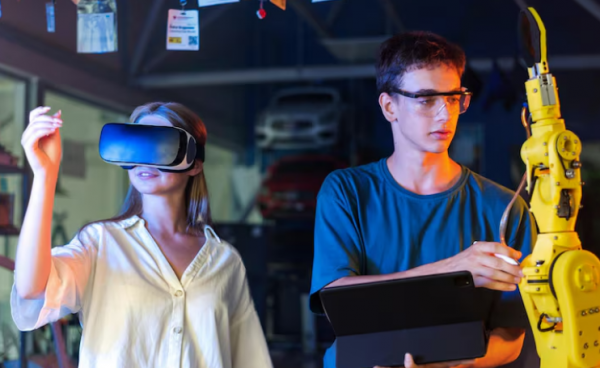
The automotive industry is currently navigating its most significant transformation since the invention of the assembly line. We are no longer just building cars; we are creating sophisticated, roaming computers that happen to have wheels. The traditional focus on horsepower and hardware is rapidly yielding ground to a new era defined by software, connectivity, and artificial intelligence.
For industry leaders and stakeholders, this shift is not merely about adopting new gadgets—it is about a fundamental restructuring of value chains, customer relationships, and business models. At the heart of this evolution lies the strategic application of Digital Technology Services, which serves as the backbone for this new mobility ecosystem. As we look toward the next decade, the convergence of electrification, autonomy, and connectivity is rewriting the rules of the road.
At STL Digital, we observe these shifts not just as technological upgrades, but as a complete reimagining of what mobility means for the consumer and the enterprise alike.
The Rise of the Software-Defined Vehicle (SDV)
The differentiator in modern vehicles is now code. In a Software-Defined Vehicle (SDV), functions are decoupled from hardware, allowing for Over-the-Air (OTA) updates that improve safety and efficiency long after the car has left the dealership.
This shift is creating immense economic value and structural change. According to the Deloitte 2026 Global Automotive Consumer Study, the industry is entering a critical phase where 52% of consumers say they would keep their vehicle longer if it received regular OTA updates, and 62% are even willing to pay above list price for such functionality. This underscores the fact that evolving revenue will be in the form of ongoing software-based services, and not in the form of hardware sale itself.
OEMs are spending a lot of money on Product Engineering to create agile Architectures, which are scalable to accommodate this software-first strategy. It not only includes rewriting the vehicle operating system, but also reconsidering the communication between disparate electronic control units (ECUs), shifting to zonal architectures that are more centralized and less complex and heavy.
AI Innovation: The Brain Behind the Wheel
If software is the nervous system of the modern vehicle, Artificial Intelligence is its brain. AI Innovation is no longer a futuristic concept reserved for fully autonomous robotaxis; it actively reinvents the driving experience through Advanced Driver Assistance Systems (ADAS), predictive maintenance, and customized in-cabin experiences
AI takes real-time data sets from LIDAR, radar, and cameras to make split-second decisions, which result in improved safety. Besides being able to keep the factory safe, AI is transforming the factory floor. Computer vision and machine learning are the tools of the so-called smart factories, which help identify defects on the assembly line more accurately than the human eye, thereby minimizing wastage and guaranteeing an increase in quality.
The effects of these technologies in terms of operational efficiency are enormous. A recent analysis by Bain & Company highlights that automotive leaders expect efficiency gains of up to 30% by 2030 as digital technologies and AI reshape their operations. This efficiency is driven by faster development cycles and AI-driven manufacturing optimizations.
In order to remain competitive, the automotive firms need to use Artificial Intelligence not as a feature, but as a core competency. Whether it’s a voice assistant with the ability to comprehend the natural language or a battery management system that could help to optimize the range depending on the driving habits, but in both cases, AI is the solution to the next level of customer satisfaction.
Connectivity and the Cloud Ecosystem
The modern vehicle is a node in a vast, interconnected network. Connected Mobility is not just a notion that involves the driver being connected to the smartphone; it is also Vehicle-to-Everything (V2X) communication. Cars can communicate with each other (V2V), the infrastructure (V2I) and even people (V2P) to make the traffic environment safer and more efficient.
Such kind of connectivity creates a huge amount of data that has to be handled, stored and analyzed safely. This is where Cloud Services are going to be absolutely necessary. The cloud is the central point that handles all the activities including fleet management systems and delivery of infotainment content. It allows car manufacturers to keep a close eye on the health of their vehicles and anticipate the breakdown of the components even before they start showing any symptoms and make a proactive appointment to service their vehicles.
The shift toward electrification further cements this digital requirement. A press release by Gartner forecasts that by 2030, more than half of all vehicle models that an automaker markets will be electric vehicles.
Nonetheless, this connectivity comes with issues, in terms of data privacy and cybersecurity. With more connectivity between vehicles, there are cyber threats that can target them. Incorporation of secure Digital Technology Services will be very necessary because as cars get smarter, they become secure as well as trusted by the consumer.
Building Resilience Through Digital Foundations
In a fast changing world, as much as innovation is essential to automotive businesses, resilience is equally important. The dynamic and unpredictable market, supply-chain limitations, and changing regulatory needs require future-ready, scalable, and adaptive systems. A robust digital base helps organizations to move quickly both in the reconfiguration of production schedules, software roadmap adjustments, or the introduction of new services before their rivals. Through the integration of automation and data-driven decision-making throughout its operations and engine, the automotive companies can be more transparent, less risky, and continuity-focused and accelerate transformation in an ever-more unpredictable global context.
Customer-Centricity as the New Competitive Advantage
As vehicles become more intelligent, customer expectations are evolving just as rapidly. Today’s automotive consumer values seamless, digital-first experiences as much as performance and design. From intuitive purchase journeys to personalized, software-enabled ownership experiences, customer-centricity is emerging as a decisive differentiator. Automakers that leverage insights from connected vehicles and digital platforms can anticipate customer needs, deliver tailored services, and foster long-term loyalty. In this experience-driven economy, success will belong to organizations that place the customer at the center of every mobility and digital innovation.
Transforming Business Models
The technological revolution is forcing a parallel Digital Transformation in Business models across the automotive sector. The traditional “make-and-sell” model is evolving into a “subscribe-and-service” model.
Car manufacturers are also investigating subscription-based services, like heated seats, sophisticated navigation, or even full self-driving, which can be turned off and on at the user level. The benefit is that this Feature-as-a-Service business model generates a revenue stream on a recurring basis and enables a more customized ownership experience.
Furthermore, the industry is experiencing the emergence of mobility-as-a-service (MaaS), in which the emphasis is no longer on owning a vehicle but on the usership. This will need complex backend systems that can handle fleet activities, user payments and dynamic routing.
The adoption of these new models will need a modified and liberalized IT environment. Business organisations are progressively resorting to Enterprise Transformation solutions as a way of integrating their legacy systems with the current digital platforms. This integration will make sure that data is transferred smoothly between the manufacturing floor, showroom, and finally to the vehicle in the road which is connected.
The Road Ahead
The automotive industry is in a state of flux, but the direction of travel is clear. The successful ones in this new landscape will be those who are able to combine their manufacturing legacy with global software and digital solutions.
It involves a comprehensive process in which Digital Technology Services are not seen as an add-on but rather seen as part of the organizational strategy. Every digital touchpoint is a value creation point, whether it is the cloud infrastructure that enables OTA updates to the AI algorithms that enable autonomous driving.
In the future, teamwork will play an important role. It is an intricate ecosystem where no one company can be competent in everything. The next generation of mobility will be based on partnerships between established OEMs and technological giants and agile digital service providers.
At STL Digital, we are committed to help organizations in navigating this complex terrain, ensuring that they are not just passengers in this revolution, but are the ones driving it.